
« Traduction, Adaptation, Invention en Europe à l’époque de la première modernité »
-
Du 17 Sep. 2026 au 18 Sep. 2026
-
Europe et renaissance
-
Salle des Actes, Sorbonne Université
-
Alexis Tadié
Programme
Jeudi 17 septembre
10h00
Accueil des participants et ouverture du colloque
Session 1 : Éditer, interpréter, écrire
10h30
Éditer les Hymnes de Ronsard : la contextualisation au service de l’interprétation
Paul-Victor Desarbres (Sorbonne Université)
10h50
Montaigne : l’essai et l’ascèse. Des Exercices de l’âme à l’écriture de soi
Alexandre Tarrête (Sorbonne Université)
11h10
Questions
Session 2 : Traducteurs et traductions
11h20
Aphra Behn et la France
Line Cottegnies (Sorbonne Université)
11h40
Traduire Bacon en France aux XVIIe et XVIIIe siècles
Sylvie Kleiman-Lafon (Université Paris-Nanterre)
12h
Questions
12h30
Déjeuner
Session 3 : La circulation des idées en Europe
13h30
Adapting the Culinary in Rabelais’s Third Book
Kathryn Banks (Durham University)
13h50
L’Utopie de Moore comme pépinière
Richard Scholar (Durham University)
14h10
Présentation de l’ouvrage : Philosophies : féminin pluriel. Anthologie de textes de femmes philosophes.
Anne-Lise Rey (Université Paris-Nanterre)
14h30
Questions puis pause (15h-15h15)
Session 4 : Littérature, émotions et sensibilités
15h15
'Ha, ha, ha': Reading Restoration Plays through the Lens of Comedy Studies
Clara Manco (Université Paris-Cité)
15h35
Performing the Self: Sarah Fielding and the Eighteenth-Century Woman Writer
Emma Quiriconi (Doctorante, Sorbonne Université)
15h55
What's in a name in Voltaire's L'Ingénu and its translations
Rob Twiss (Durham University)
16h15
Questions
16h45
Fin de journée
20h
Dîner de colloque
Vendredi 18 septembre
Session 5 : Écrire la procréation et la naissance au début de l’ère moderne
10h
Pour une « natalogie » : textes et discours sur la naissance à l’époque de la première modernité (France, mi-XVe–mi-XVIIe siècle)
Jean-Charles Monferran (Sorbonne Université)
10h20
Lexique et mise en récit : étudier les écrits en français sur la procréation avec des outils littéraires (1530-1640)
Zoé Weil (Doctorante, Sorbonne Université)
10h40
Questions puis pause (11h-11h15)
Session 6 : Transformations de la littérature et de ses pratiques
11h15
The Little House: Horace Walpole, John Summerson, and Literary Architecture
Fiona Robertson (Durham University)
11h35
The Art of Dying? Nature, Artifice and the Early Modern Invention of Death
Elizabeth Swann (Durham University)
11h55
Questions
12h15
Déjeuner
Session 6 bis : Transformations de la littérature et de ses pratiques
13h30
From physical conflict to judicial conflict: the translation of officerial violence in the Dutch States Army, 1688-1697
Joost Oosterhuis (Doctorant, Durham University)
13h50
Stagnant Law, Depravity and the English Stage: A Study of Percy Shelley's The Cenci
Sofia Sierra (Doctorante, Sorbonne Université)
14h10
From Don Quixote to The Female Quixote: Cross-Gender Adaptation and European Reception in Eighteenth-Century England.
Alice Tartari (Doctorante, Sorbonne Université)
14h30
Questions et conclusions
Organisation
- Line Cottegnies (VALE, Sorbonne Université)
- Julien Goeury (CELLF, Sorbonne Université)
- Adeline Lionetto (CELLF, Sorbonne Université)
- Richard Scholar (Durham University)
- Alexis Tadié (VALE, Sorbonne Université)
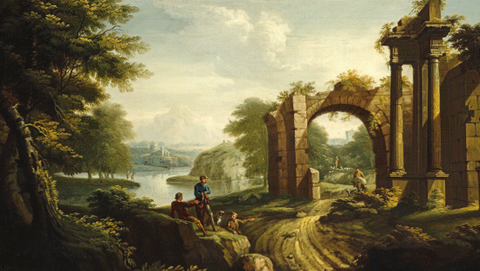
Source image : James Norie, Classical Landscape with Architecture, 1736 Oil on canvas, 68 x 136 cm, National Gallery of Scotland, Edinburgh
Organisé avec le soutien de Durham University, Sorbonne Université, CELLF, VALE, Initiative Europe, Ecole Doctorale 3, Ecole Doctorale 4.